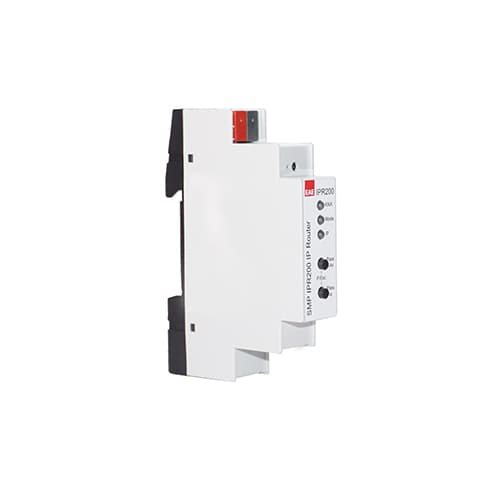
The EAE IPR200 KNX IP Router connects a KNX twisted-pair (TP) line to an Ethernet (IP) network using the KNXnet/IP protocol. It operates as a line or backbone coupler, forwarding telegrams between KNX segments over LAN as a fast IP backbone — and simultaneously as a tunneling interface for ETS programming, monitoring, and visualization tools.
The IPR200 provides galvanic isolation between the KNX bus and the IP network. Its extended filter table for main groups 0–31 controls which telegrams cross the boundary, with an on-device button to disable filtering for commissioning diagnosis. The IP address is assigned via DHCP or static configuration in ETS. Power is drawn from the KNX bus — no separate mains supply is required.
Key Features — Routing, Tunneling, and Filtering
Network Coupling
- KNXnet/IP routing: Fast backbone coupling between KNX TP lines via LAN (IP).
- KNXnet/IP tunneling: Up to 5 simultaneous tunneling connections for ETS, group monitor, and visualization access.
- Galvanic isolation: Electrical separation between KNX TP and IP network segments.
- Telegram buffer: Buffers up to 150 telegrams for reliable routing under load.
Filtering and Diagnostics
- Extended filter table: Block or allow telegrams for main groups 0–31 between KNX and IP.
- Filter bypass: On-device function buttons disable the filter table for quick diagnosis during commissioning.
- Status LEDs: Six multicolour LEDs show KNX bus traffic, IP link status, mode, and communication errors.
- Front-panel programming: KNX programming button and optional programming mode activation without opening the panel door.
At a Glance
| Specification | Detail |
|---|
| Product type | KNX IP Router — routing and tunneling |
| Order code | IPR200 (SMP IPR200) — EAE order no. 50563 |
| Bus systems | KNX TP ↔ KNXnet/IP (Ethernet) |
| Tunneling connections | Up to 5 simultaneous KNXnet/IP tunneling clients |
| Filter table | Extended — main groups 0–31 |
| Ethernet | 10BaseT (10 Mbit/s), RJ45 |
| IP configuration | DHCP or static (ETS) |
| Power supply | KNX bus — approx. 15 mA (21–30 V DC SELV) |
| Dimensions (H × W × D) | 90 × 18 × 70 mm (1 MW) |
| Mounting depth | 64 mm |
| Weight | 40 g |
Full electrical ratings and classification data are listed under Technical Specifications. Datasheet, product manual, installation manual, ETS application, and certificates are under Downloads.
Applications and KNX Integration
- IP backbone: Connect multiple KNX lines or areas over Ethernet instead of cascading TP line couplers across long distances.
- Remote commissioning: ETS programming and group monitor access via LAN without a USB interface at the panel.
- Multi-client access: Up to five simultaneous tunneling sessions for ETS, visualization, and monitoring tools on the same installation.
- Structured segmentation: Filter tables limit cross-segment traffic — pair with the EAE LC200 Line Coupler for TP-side line/sub-line separation.
- System power: Supply KNX lines from an EAE PS640 KNX Power Supply; for hotel GRMS where Modbus TCP replaces per-room IP routers, see the EAE KMG103 KNX/Modbus Gateway.
Choosing EAE System Devices
The IPR200 is the full router — routing plus tunneling with filter-table control and five tunneling clients. For TP-only line coupling without IP, use the compact EAE LC200 Line Coupler (1 MW, galvanic isolation, filter table). For hotel room topologies that integrate PSU, Modbus TCP, and energy-saving logic in one module, choose the KMG103 Gateway instead of a separate PSU plus IPR200 per room.